
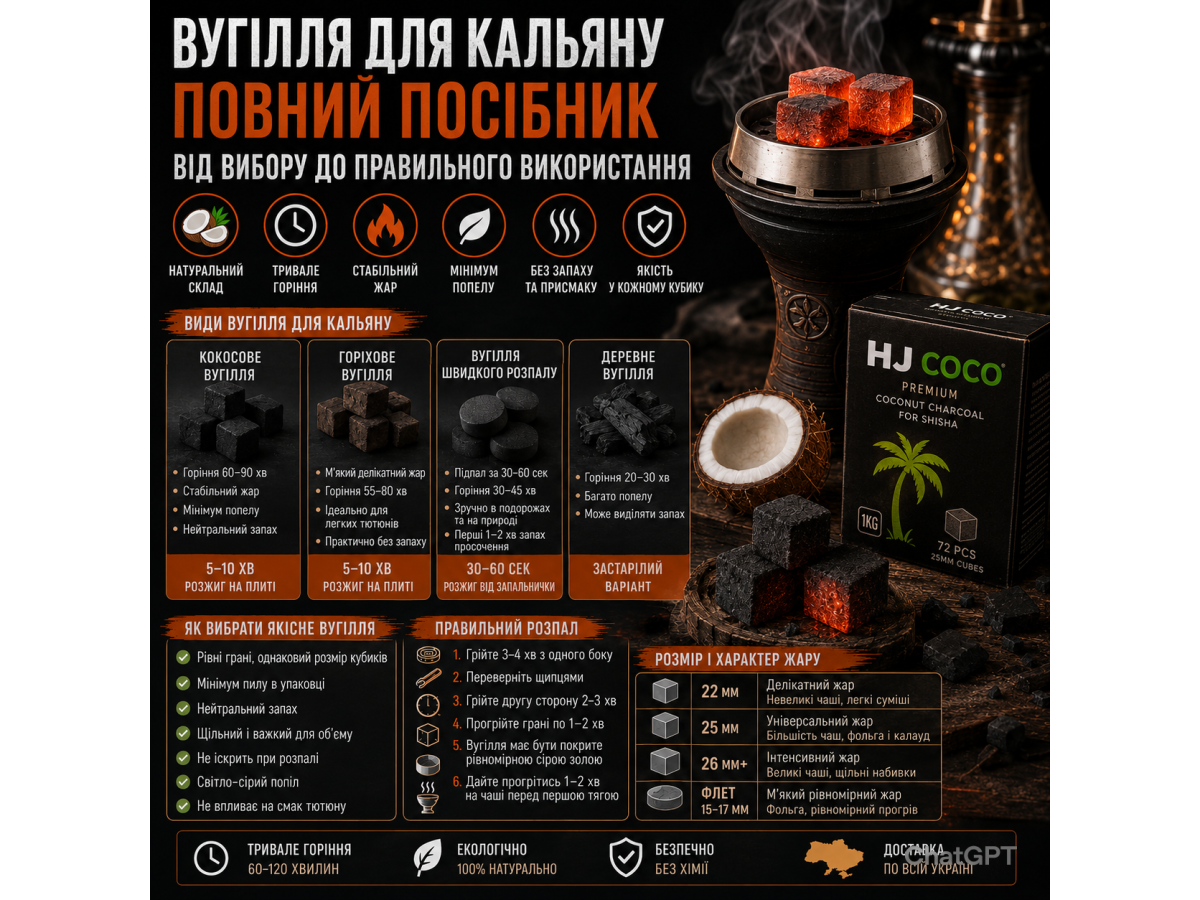
Hookah Coals: A Complete Guide from Selection to Proper Use
Coal is one of the key elements of a quality hookah session. Good coal maintains stable heat, does not interfere with the tobacco flavor, and leaves minimal ash. Bad coal tastes bitter, cracks, goes out quickly, and ruins even expensive tobacco. In this guide, I will tell you everything you need to know about hookah coals: what they are made of, what types exist, how to choose, light, and store them - and answer questions that are rarely found in ordinary articles.
What is hookah coal and why is it needed
Hookah coal is a consumable material that heats the tobacco in the bowl to an operating temperature of 180-220°C. Unlike cigarettes, where tobacco burns directly, in a hookah the tobacco does not burn - it smolders under the heat from the coal through foil or a heat management device. This is why the choice of coal directly affects the flavor, smoke density, and session duration.
Proper coal must solve three tasks: heat the tobacco to the right temperature, maintain that temperature stably throughout the session, and not introduce any foreign odors or flavors. Sounds simple - but in practice, this is exactly where cheap coals have problems.
What coconut coal is made of
Coconut coal is the most popular type of hookah coal today. It is produced from coconut shell, which is a waste product of the food industry. The production cycle includes several stages: the shell is dried, burned at high temperature without oxygen - this process is called pyrolysis - then ground to a powder, mixed with a natural binder (most often tapioca), and pressed into cubes under high pressure.
The higher the pressing pressure and the higher the percentage of carbon in the finished product, the better the coal. Good coconut coal contains 75-80% carbon, has a moisture content of no more than 8%, and an ash content of 2-5%. These indicators determine the burn time, heat stability, and amount of ash.
Nut coal - Gresco, Mind, Coco White - is produced similarly but from walnut or hazelnut shells. The process characteristics are the same, but the final product provides a softer, more delicate heat.
Types of hookah coal
Coconut coal - the industry standard. Natural coconut shell, long burning time of 60-90 minutes, stable heat, minimal ash, neutral odor. Requires a stove or burner for lighting - 5-10 minutes. Suitable for most tasks from home sessions to professional hookah lounges. Coconut coal occupies 90% of the hookah coal market in Ukraine.
Nut coal - produced from nut shells. Provides a softer, more delicate heat compared to coconut - ideal for light and floral tobaccos. Burns for 55-80 minutes. Almost no smell when lighting. In terms of burning quality, the best nut coals like Mind approach coconut coals.
Quick-light coal - tablets impregnated with an易燃 composition. Lights from a lighter in 30-60 seconds, no stove required. Burns for 30-45 minutes. The first 1-2 minutes give off a smell of the impregnation which then disappears. Indispensable outdoors and while traveling. Popular brands: Three Kings, Holland Quick Lighting.
Wood coal - the cheapest type. Produced from different types of wood. Lights quickly, burns for 20-30 minutes, produces a lot of ash and often emits a smell when burning. Today it is practically pushed out of the market by coconut coal - used only by beginner hookah makers due to its low price.
Why coconut coal became the industry standard
Until the mid-2000s, hookah makers used ordinary wood coal. The transition to coconut happened for clear practical reasons. First - burning time: coconut burns 2-3 times longer than wood. Second - heat stability: coconut maintains an even temperature, without sharp fluctuations that overheat or cool the tobacco. Third - neutral odor: good quality coconut coal does not introduce any foreign taste into the session.
An additional factor is environmental friendliness. Coconut shell is a waste product of the food industry. Coal from it is produced without cutting down trees - a sustainable renewable resource. That is why large international brands position coconut coal as an environmentally friendly product.
How to choose quality coal - signs of a good product
How to understand the quality of coal before buying and first use? There are specific signs that can be assessed visually and tactilely.
Appearance of the cubes. Good coal has smooth edges without cracks or chips. All cubes in the package are the same size - this is a sign of a stable production process with quality control. Uneven, different sized cubes with cracks - a sign of cheap production with minimal control.
Dust in the package. Open the package and look at the bottom. Minimal coal dust is a sign of high pressing density. A lot of dust means the cubes crumble during storage and transportation - such coal will fall apart when heated.
Smell of the package. High-quality coconut coal without chemical impurities has almost no smell at room temperature. A sharp chemical smell from an unopened package is a signal of the presence of binders or accelerators.
Weight of the package. Dense pressed coal is heavier than loose coal. If the package feels light for its volume - the pressing density is low, which means less carbon and shorter burn time.
| Sign | Good Coal | Bad Coal |
|---|---|---|
| Cube shape | Smooth edges, same size | Chips, cracks, different sizes |
| Dust in package | Minimal | Lots of dust at the bottom |
| Smell | Neutral or mild coconut | Sharp chemical smell |
| Weight | Dense, heavy for its volume | Light, feels loose |
| When lighting | Does not spark, heats evenly | Sparks, cracks, uneven heating |
| Ash when burning | Light gray, little, easily knocked off | Dark, a lot, sticky |
| Tobacco flavor | Unchanged, clean aroma | Bitterness, foreign aftertaste |
What cube size to choose
The cube size affects the intensity of the heat and the convenience of working with the bowl and heat management device. There is no universal rule - the choice depends on the bowl, packing method, and personal preferences.
| Size | Heat Character | Best for |
|---|---|---|
| 22 mm | Delicate | Small bowls, light blends, precise heat management |
| 25 mm | Universal | Most bowls, foil and HMD, any tobacco |
| 26 mm+ | Intense | Large bowls, dense packs, heat-resistant tobacco |
| Flat (15-17 mm height) | Soft, even | Foil, even heating across the whole bowl |
The simplest rule: start with 25 mm. This is the gold standard that works with 90% of bowls and tobaccos. If you need more heat, switch to 26 mm or add a cube. If the heat is excessive, try 22 mm or flats.
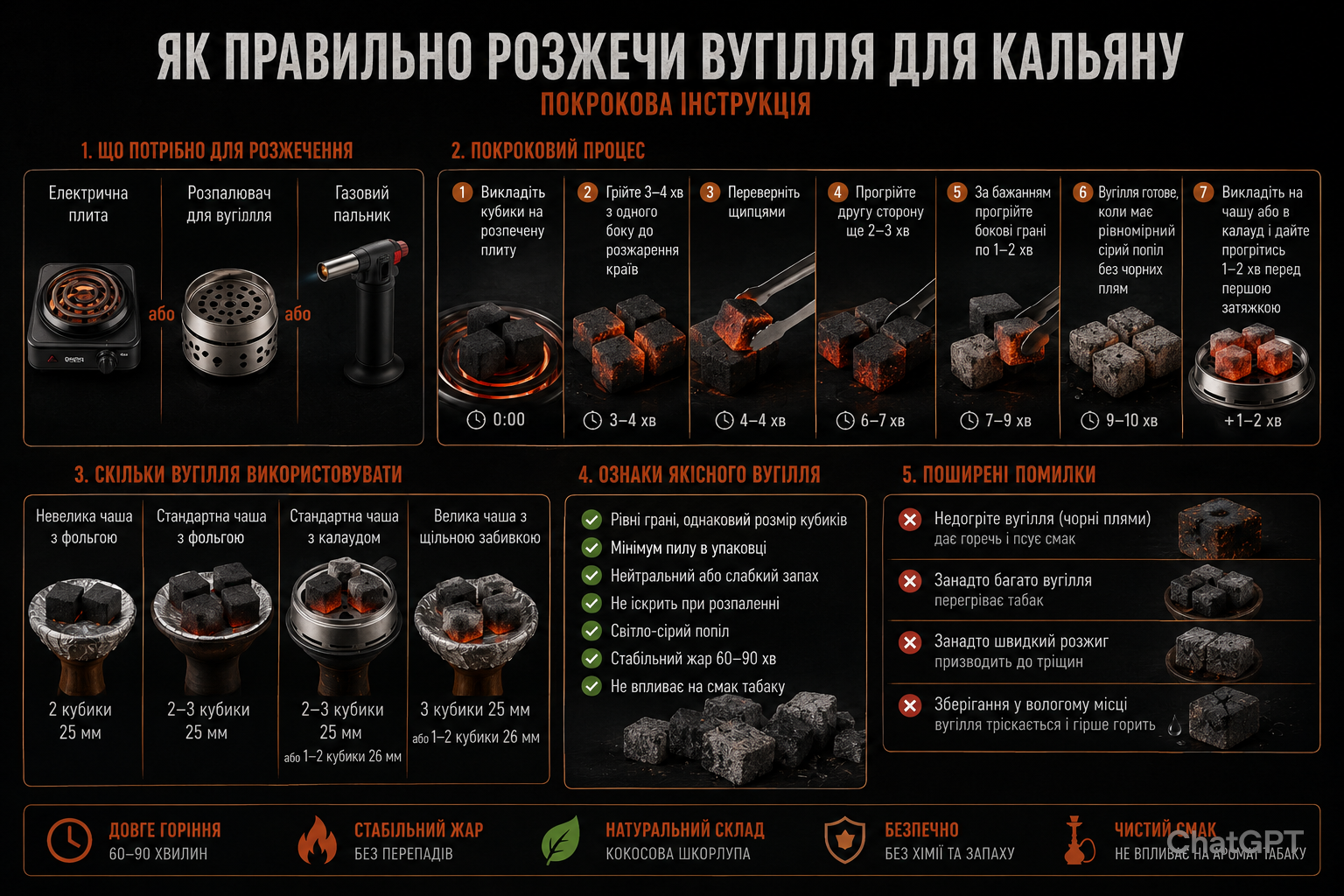
How to properly light hookah coal
Proper lighting is the main condition for a good session. Most problems with a hookah: bitterness, weak smoke, going out quickly - are solved by properly heating the coal.
What you need for lighting coconut coal: an electric stove with an open coil or a special coal burner. A gas stove with a diffuser is not suitable - uneven heating. You can use a gas torch with an open flame.
Step-by-step lighting:
- Place the cubes on a heated stove or burner
- Heat for 3-4 minutes on one side until the edges are red hot
- Flip with tongs - never with your hands, the coal is very hot
- Heat the second side for another 2-3 minutes
- Optionally, heat the side edges for 1-2 minutes each
- The coal is ready when it is covered with an even gray ash on all sides without black spots
- Place on the bowl or in the HMD and let it heat for 1-2 minutes before the first puff
The main mistake is underheated coal. If there are black areas on the cube without gray ash - it is underheated. Underheated coal causes bitterness and bad taste. Do not rush: it is better to spend an extra 2-3 minutes on lighting than to ruin the entire session.
How much coal to use per session
The amount depends on the bowl size, packing type, and method. The general rule: start with a minimum and add if necessary. Excess coal overheats the tobacco, causing bitterness and dryness.
- Small bowl with foil - 2 cubes of 25 mm
- Standard bowl with foil - 2-3 cubes of 25 mm
- Standard bowl with HMD - 2-3 cubes of 25 mm or 1-2 cubes of 26 mm
- Large bowl with dense pack - 3 cubes of 25 mm or 2 cubes of 26 mm
After 15-20 minutes of the session, assess the heat. If the draw is easy and the smoke is thick - the amount is optimal. If the hookah is barely drawing - add one cube. If there is bitterness or overheating - remove one cube or move it to the edge of the bowl.
Common problems with coal - causes and solutions
Why does the coal make it bitter? Three main reasons. First - the coal is underheated, with black areas remaining. Solution: heat completely until gray ash. Second - too much coal on the bowl. Solution: remove one cube. Third - low quality coal with impurities. Solution: change the brand.
Why does the coal spark when lighting? Reasons: poor carbonization of the raw material, presence of impurities in the composition, violation of production technology. Sparking is a sign of low quality coal. Good coconut coal does not spark when lit properly. If the coal constantly sparks - change the brand.
Why does the coal crack during heating? Cracks during heating appear due to residual moisture inside the cube. When heated, the water turns into steam and literally breaks the cube from the inside. Reason: high coal humidity (norm is up to 8%, bad coal can have 15-20%). The second reason is lighting too quickly: if you put cold coal on a very hot stove immediately - the temperature difference causes cracks. Solution: use quality coal from trusted brands and do not rush the lighting.
Why does the coal go out quickly? Three reasons. Low carbon percentage in the composition - cheap raw material simply does not provide long burning time. High coal humidity - damp coal burns poorly. Insufficient heating - coal that has not reached operating temperature goes out quickly. If good coal goes out on the bowl - the problem is insufficient hookah draw or too dense a pack.
Why did the coal stink when lighting? For natural coconut or nut coal without chemicals, a faint smell of coconut or nut is typical when lighting, which disappears after full heating. A sharp, unpleasant smell is a sign of residual organic matter in the raw material, chemical binders, or combustion accelerators. During the session, good coal does not emit any smell.
Why does the coal get a white coating? The white coating on the surface is the gray ash, a sign that the coal is ready for use. Many beginner hookah makers mistakenly mistake this for a defect. In fact, an even white or gray coating over the entire surface means the coal is fully heated and ready.
Does coal affect the taste of hookah? Good coal - practically no effect. Natural coconut or nut coal without chemical additives, when properly heated, does not introduce any foreign taste. Bad coal has a significant effect: bitterness, chemical aftertaste, a feeling of "smoke". That is why it is worth buying good coal for expensive tobacco - otherwise, the whole point of paying extra for quality tobacco is lost.
Which coal to choose for home use
For home use, coconut coal in a standard 25 mm cube is optimal. The specific brand depends on the task. If you want reliable coal at an affordable price - Monster Coco or Hj Coco. If long burning time is important - Eskobar with 120 minutes of burn time or Queen Coco. If you smoke light floral blends - try Gresco nut coal or Mind - the soft heat better reveals delicate aromas. If you don't have a stove or are using the hookah outdoors - quick-light coal Three Kings or Holland.
Which coal to choose for a hookah lounge
For professional hookah lounges, the requirements are different: quality stability from batch to batch, long burning time (fewer replacements - fewer distractions from guests), minimal ash, and preferably a recognizable brand. The best options for establishments:
- CocoBrico HORECA - a series specially designed for professional establishments, lighting time 4-6 minutes, cube uniformity from batch to batch
- Eskobar - burns for 120 minutes, does not go out during the session
- Tom Coco Gold - European brand, wide range of formats for any bowls
- Yahya Coco - a popular choice for hookah lounges, special Kaloud formats
Can unburned coal be reused?
Yes - this is common practice. If the coal has gone out but retains its shape and has not crumbled - it can be lit again. Place the coal remnants on the stove along with new cubes and heat as usual. The burning time of re-lit coal will be shorter - about half of the original. Store unburned coal in a dry place - wet coal will crack and fall apart when re-lit.
How to store hookah coal
The main enemy of coal is moisture. Damp coal lights poorly, cracks when heated, smokes, and can give off a foreign smell. Storage rules are simple:
- Keep in a closed package in a dry place
- Do not store in the bathroom, kitchen near the stove, or on the balcony in wet weather
- Opened packages without a box - transfer to an airtight container or zip bag
- Do not allow contact with water - even slight wetting ruins the coal
- When stored properly in a dry place, the shelf life is unlimited
Can coal be stored on the balcony in winter? Provided that the balcony is glazed and there is no direct precipitation - yes. Frost does not harm the coal. Only moisture harms: if there is condensation or dampness on the balcony - the coal will spoil.
My experience using different brands
Over several years of working with hookah coals, I have tested dozens of brands on different bowls and tobaccos. The difference between good and mediocre coal becomes noticeable within 20-30 minutes of a session. Here are practical observations.
Quality coal maintains stable heat without intervention - you put it on, light it, and the hookah works by itself. Cheap coal constantly requires control: sometimes it overheats, sometimes it cools down, sometimes it goes out. During a session with bad coal, the hookah maker spends so much effort controlling the heat that the pleasure of the session itself is lost.
I discovered nut coal quite late. For a long time, I considered it a "coal compromise" - worse than coconut in every way. The Ukrainian brand Mind changed this perception: nut coal that really does not yield to coconut analogues in burning quality, while providing a delicate heat that is better suited for certain tobaccos.
The most important thing I learned in practice: expensive coal is not always better. Monster Coco is affordable but gives a stable result that satisfies most hookah makers. CocoBrico with 20 years of production history and a 4-6 minute lighting time - one of the best in terms of price-quality ratio. Eskobar with 120 minutes of burn time - an unequivocal choice for long sessions and professional hookah lounges.
Frequently asked questions about hookah coal
Is it true that expensive coal is always better?
No. The price of coal is determined by the brand, packaging, and marketing - not always by burning quality. Many affordable coals like Monster Coco or Hj Coco give results comparable to more expensive European analogues. Focus on specific characteristics: burning time, ash content, reviews - not just price.
Why does new coal burn worse than the old trusted brand?
Brands change raw material suppliers or production processes. Quality can vary from batch to batch. If a familiar brand suddenly becomes worse - it is not always an accident. Buy a small package of a new brand for comparison. Consistency of quality from batch to batch is one of the main characteristics of a good manufacturer.
Which coal produces the least ash?
Ash content depends on the quality of raw materials and the percentage of carbon in the finished product. Amy Deluxe declares the lowest ash content (2%). Eskobar and Coco White have good indicators. Coconut coal generally produces less ash than nut coal, and nut coal less than wood coal. Light gray, easily knocked-off ash is a sign of quality natural coal.
How does air humidity affect coal?
High air humidity gradually penetrates the coal through an unsealed package. The coal absorbs moisture and deteriorates: it takes longer to light, may crack when heated, and holds heat worse. In regions with high humidity, it is especially important to store coal in tightly sealed containers.
How much coal is needed for one bowl and how not to make a mistake?
The standard is 2-3 cubes of 25 mm. Start with 2 cubes and assess the heat after 5-7 minutes of starting. If the draw is easy and the smoke is thick - everything is correct. If the hookah is barely drawing - add a third cube. If bitterness or dryness appears - remove one cube. Over time, you will understand the ideal amount for your specific bowl and packing.
Why do some coals go out quickly on the bowl?
Three reasons. First - the coal itself: low carbon percentage or high humidity. Second - insufficient heating: the coal did not reach operating temperature. Third - a problem with the hookah draw: too dense a pack does not allow air to pass through, and the coal goes out due to lack of oxygen. Diagnosis: if the coal goes out in the first minutes - the problem is with the lighting. If after 30-40 minutes - this is normal burnout for some brands.
Can open coal be stored in the refrigerator?
No - a bad idea. The refrigerator has high humidity, and when you take the coal out, condensation forms on it due to temperature changes. The best place for storage is a dry cabinet or shelf away from sources of moisture at room temperature.
Is it necessary to blow on the coal to make it light faster?
This is common practice and it works - the influx of oxygen accelerates combustion. But there is a nuance: if you blow on the coal that is lying on the bowl, the air flow cools one side of the coal. It is better to remove the coal with tongs, blow it away, and return it to the bowl. A more elegant solution is to turn and move the coals with tongs: the fresh surface comes into contact with oxygen and the coal lights itself.
Where to buy hookah coal with delivery in Ukraine
Smokyloot.com offers the widest selection of hookah coal in Ukraine: coconut coal from Monster Coco, Tom Coco, Eskobar, Gorilla, Phoenix, Queen Coco, Hj Coco, Panda, Yahya, Khmara, CocoBrico, Amy Deluxe, Garden and other brands; nut coal Gresco, Mind and Coco White; quick-light coal Three Kings, Holland, Al Fakher and others. Delivery throughout Ukraine by Nova Poshta and Ukrposhta. Retail and wholesale, payment upon receipt or online.
Choose coal by characteristics, not by price - the Smokyloot catalog has options for any budget and any task.
Full coal catalog Wholesale prices
Write a comment